SCHUFA Entry: What is it? What’s in Your Record?
Almost everyone "has a SCHUFA entry" or, more accurately, is listed in the SCHUFA database. Over 90% of those listed have only positive entries (yes, that’s possible). Do you have negative or only positive entries? Here, you can find out how to check your SCHUFA entries for free using bonify.

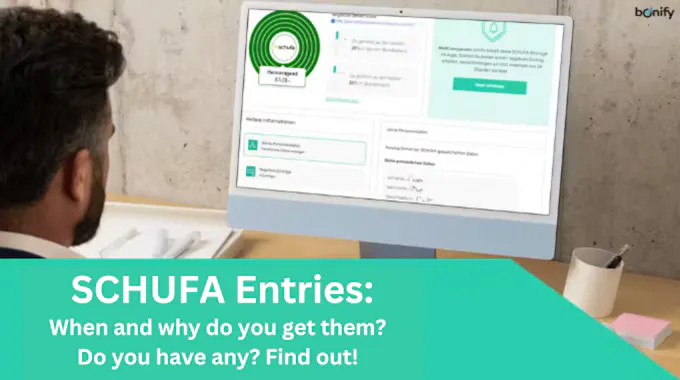
bonify helps reduce the anxiety regarding SCHUFA records! As mentioned, most people (over 90%) have only positive entries, which can actually enhance your creditworthiness. A SCHUFA entry is generally not a bad thing—it can even be a good thing.
But you don’t know what your entries are? We can change that! As part of SCHUFA’s transparency initiative, you can review your SCHUFA credit report with bonify.
You can check your SCHUFA Basisscore and any negative SCHUFA entries by identifying yourself with your ID or bank account (note: no transactions are checked).
For access to additional entries and credit inquiries, you’ll need to verify yourself with the online ID function (eID).
The best part? It’s free, works online via web or app, and within minutes, you’ll have access to your data!
What is a SCHUFA Entry?
A SCHUFA entry refers to any information recorded in your credit file at SCHUFA. This includes data obtained from public registers or from SCHUFA's nearly 10,000 contractual partners.
Wait, What Exactly is SCHUFA?
SCHUFA (Schutzgemeinschaft für allgemeine Kreditsicherung) is Germany's largest credit agency. It's a private company based in Wiesbaden and has become almost synonymous with creditworthiness or credit ratings in Germany.
There are other credit agencies, such as Crif, Boniversum, or Experian, though they are less well-known.
What Do Credit Agencies Do?
Credit agencies collect data and calculate a score that reflects your creditworthiness as a single number. For SCHUFA, this is the SCHUFA score; for Boniversum, for example, it’s the credit index.
To calculate these scores, agencies use a recognized, mathematical-statistical process called credit scoring. The more accurate and relevant the data or information (entries) they have, the more precise the score will be.
Back to the Entry:
Entries often influence your credit score. They can have either a positive or negative impact on your score.
This score is then used by companies to assess your creditworthiness. In addition to their internal credit scoring, your SCHUFA score helps businesses make informed decisions:
Will you get the contract?
If so, under what terms and conditions?
It’s essential to monitor your score and entries. A good score and positive entries can work to your advantage, while negative entries can pose challenges. A strong credit score and positive entries can even help you secure better contract terms.
Why Does SCHUFA Use a Credit Score?
There are multiple reasons and benefits:
For SCHUFA’s partners, it minimizes financial risk and protects them from defaults.
Lower overall risk benefits everyone with “good SCHUFA” by providing better terms and lower interest rates.
In the past, your appearance, your car, or your suit may have played a big role in whether you got a contract. Before credit agencies, your creditworthiness might have been judged by forceful means (like organized crime “evaluating” your finances).
If you have a bad credit score, the system protects you from overspending and excessive debt.
When Do You Get a SCHUFA Entry?
When you open a bank account or get a credit card, you agree to data being shared with SCHUFA (SCHUFA disclosure), and SCHUFA records it immediately. These are positive entries, which is in your best interest.
You’re probably wondering, though, when a negative entry occurs. Does forgetting to pay once and receiving a first reminder result in a negative entry? No!
Everyone can overlook an invoice, and even a reminder isn’t a reason to worry.
When Do You Get a Negative SCHUFA Entry?
For a negative entry to occur, all of the following conditions must be met:
You have been reminded in writing at least twice.
The first reminder must have been issued at least four weeks before the entry.
You were warned about the potential SCHUFA entry.
You have not paid the outstanding amount at the time of the entry.
You have not disputed the claim.
If you receive an incorrect reminder, you must respond and object.
Do You Have a Negative Entry?
Bonify can show you your negative entries and notify you within 24 hours if new ones occur. Notifications are sent via email or push message—entirely free of charge.
Where Does SCHUFA Get Data for Its Entries?
SCHUFA obtains the data that forms the basis of all its entries from partner companies as well as publicly accessible sources:
SCHUFA’s partner companies include service providers, insurance companies, telecommunication providers, mail-order retailers, banks, and savings banks. If, as a consumer, you agree to the so-called SCHUFA notice when signing a contract with one of these partner companies, the company is allowed to share information with SCHUFA.
Publicly accessible sources are also evaluated by SCHUFA. These include information from debtor registers at local courts, insolvency data from public records, and official announcements.
It’s possible that a company works not only with SCHUFA but also with other credit agencies. However, it’s rare for companies to collaborate with all German credit agencies. This is why data from different credit agencies may vary.
What Data Does SCHUFA Use?
SCHUFA collects and stores information about:
• Current accounts and credit cards
Installment loans, real estate loans, or leasing contracts
Online or mail-order purchases made on invoice or installment payments
Information about undisputed, due, and repeatedly reminded or legally titled debts
Data from public debtor registers and official announcements
Credit scores
Personal data
What SCHUFA Does NOT Collect or Store?
SCHUFA does not collect or store information about:
Your assets or income
Data about your personal shopping habits
Information about your job
Your lifestyle, religion, or political views
Marital status
Nationality
How Long Do SCHUFA Entries Stay on Record?
All SCHUFA entries are stored for a specific period and are subject to deletion deadlines. Correct entries are automatically deleted without any action required on your part. Depending on the type of entry, the retention periods range from 6 months to 10 years.
Most entries are deleted exactly three years after they are settled. However, entries related to current accounts are deleted immediately after the account is closed. There are exceptions, and for a better overview, you can refer to our article on SCHUFA deletion deadlines.
Can SCHUFA Entries Be Deleted?
Whether you can have a SCHUFA entry deleted depends on whether the entry is correct:
Correct entries are automatically deleted, and there’s not much you can do to speed up the process.
Incorrect entries, resulting from an error, can be contested and removed at any time. You can request their deletion from SCHUFA, and incorrect entries are promptly removed.
If you discover an incorrect SCHUFA entry through a check with bonify, you’ll also find a link there guiding you on the steps to take for its removal.
Errors in SCHUFA entries are rare, but you should still review your entries—especially if you’re planning to apply for a loan or enter into a contract that carries financial risk for the other party.
How Are You Informed About a SCHUFA Entry?
Positive or neutral entries: You are not notified, as you already agreed to the data transmission when signing the contract.
Negative entries: SCHUFA will inform you. If you receive your first negative entry, you’ll be notified via a letter sent to the address registered with SCHUFA. Therefore, it’s important to keep your address information up to date with SCHUFA.
Easier Notifications with bonify
Bonify can also notify you! If you want, you’ll receive a push notification or email whenever a negative entry is added to your SCHUFA credit file.
Depending on whether you use the bonify web app or the iOS/Android app, the notification will come as a push message or email.
Our notification reaches you within 24 hours, straight to your smartphone screen or inbox—whichever you prefer.

There are different ways to do it, various credit agencies, and always an online option to check your credit score at no cost. With bonify, you can check your credit score for free anytime. The best part? You can view your credit score and credit entries instantly online with bonify!

Almost every German has a SCHUFA record and a SCHUFA score. For more than 90% of people, it's very positive. Here, you'll find everything you need to know about your score and why you can check it online for free with bonify.
Automatic translation
Some of the content on our website has been automatically translated using an AI translation programme. These translations may occasionally contain errors that can lead to misunderstandings in the text. Please therefore note that the texts on our website are written in German and that the content of the German version of our website is always authoritative.